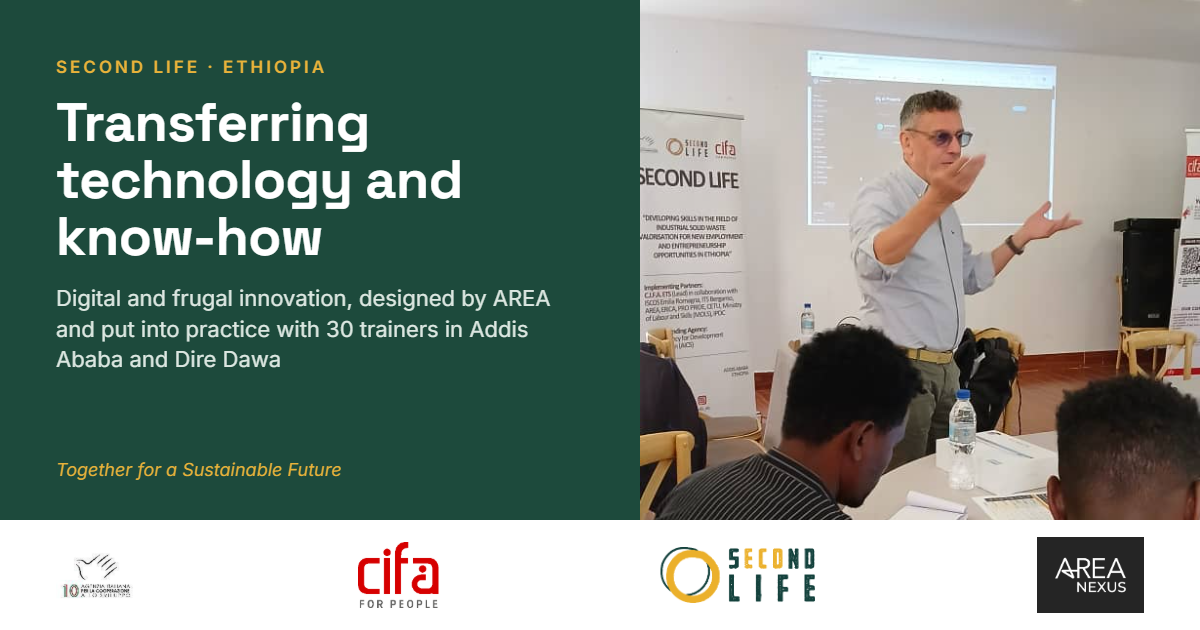
AREA turns technology into skills. We design learning pathways that combine digital innovation with frugal innovation and transfer them to local partners so that people in Africa can use today’s technology with the resources they already have. In Ethiopia, within the SECOND LIFE project co-funded by the Italian Agency for Development Cooperation (AICS), 30 trainers from Addis Ababa and Dire Dawa are now ready to pass this knowledge on.
Proven in Ethiopia
AREA’s team of experts, led by Adriano Mauro, designed the complete pathway for SECOND LIFE and transferred its technology and know-how to 30 trainers from Addis Ababa and Dire Dawa. What they achieved shows what the model can do:
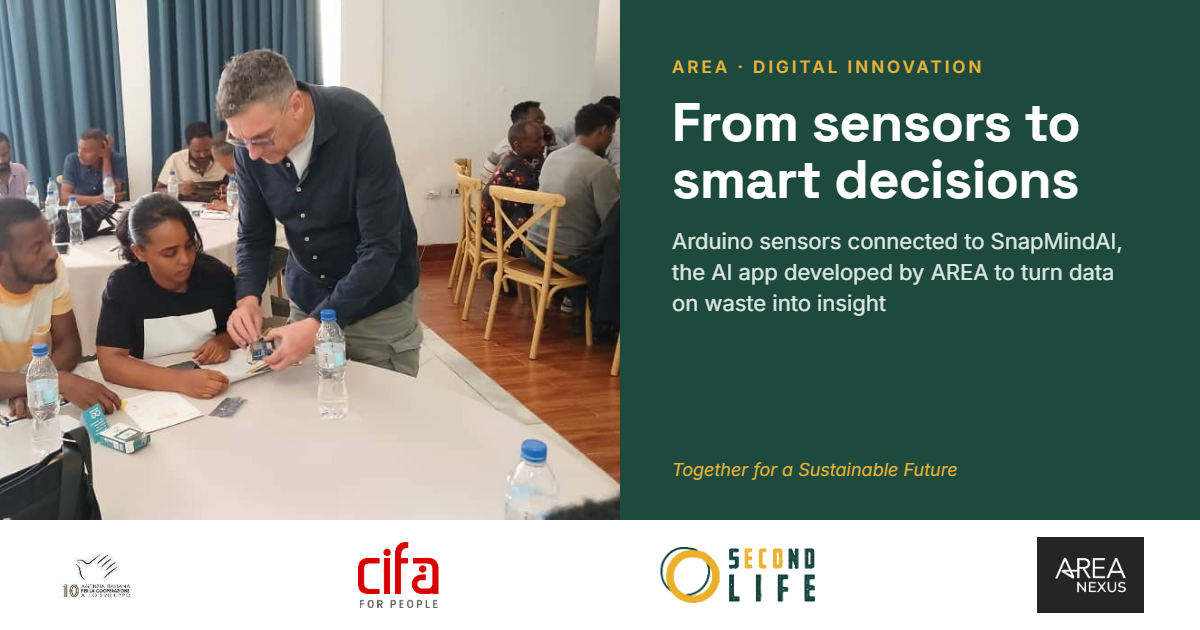
- Digital skills applied to waste. Trainers connected Arduino sensors to SnapMindAI, the AI application developed by AREA that analyses waste from a photo and estimates its material, volume, weight and market value.
- Frugal innovation with local materials. Using only used PET bottles, packaging straps and steel rods, they built two waste bin prototypes, designed as a real production process right through to commercialisation.
- Ideas that bring both together. Each trainer designed and delivered a lesson of their own, and many combined the two approaches into a smart waste management system: affordable bins made from local materials, fitted with IoT sensors that report fill levels to a dashboard for collection teams.
How AREA transfers technology and knowledge
AREA’s model rests on a simple idea: technology creates lasting impact only when people can understand it, adapt it and pass it on. That is why we pair digital tools with frugal, low-cost solutions built from locally available materials, and why every programme ends with local people able to teach it themselves. Within SECOND LIFE, this took the form of two modules: digital innovation (40 hours) and frugal innovation (16 hours).
- Blended learning on Smart Step. Self-paced online modules on Smart Step elearning platform and live sessions prepare the ground, so that time together is spent almost entirely on practice.
- Technology designed by AREA. SnapMindAI connects photo-based waste analysis with live sensor data: a ready-to-use tool that local partners and innovators can apply straight away.
- Knowledge that multiplies. AREA trains the trainers, so that skills keep spreading after the programme ends. The Ethiopian trainers are now ready to teach the frugal and digital innovation modules themselves.
A new approach to technology transfer, in the spirit of the Mattei Plan
Ethiopia is a pilot country of the Mattei Plan for Africa, Italy’s strategy for a long-term partnership with African countries built on shared prosperity. Education and training is the Plan’s largest pillar, with 24 initiatives, and it aims to strengthen teacher training, update curricula, align vocational programmes with labour market needs and involve businesses, including Italian ones. SECOND LIFE, co-funded by AICS, works in exactly this space.
Delivering on this vision takes partners that can move fast and adapt to each context. Innovative SMEs like AREA bring a different approach to technology and knowledge transfer:
- Our own technology, adapted locally. We design tools such as SnapMindAI ourselves, so we can tailor them to each context instead of exporting off-the-shelf solutions.
- Built on local resources. Frugal innovation keeps solutions affordable and easy to maintain with what is available on site.
- Scalable through digital. Platforms like Smart Step take content beyond the classroom, in seven languages including Amharic.
- From skills to enterprise. Hackathons and start-up support turn new knowledge into ideas, jobs and businesses.
- A compact team of experts. Led by Adriano Mauro, AREA’s team can design, build and teach, which shortens the path from technology to impact.
About SECOND LIFE
Co-funded by the Italian Agency for Development Cooperation (AICS), SECOND LIFE (“Developing skills in the field of industrial solid waste valorisation for new employment and entrepreneurship opportunities in Ethiopia”) aims to improve access to, and the quality of, vocational training in Ethiopia, with particular attention to women and disadvantaged groups. It strengthens the TVET system in the green economy, building new skills in waste management and supporting the social and labour inclusion of vulnerable people.
The project works with TVET institutions and with companies in the industrial parks of Addis Ababa and Dire Dawa. Its targets include new waste management courses, 500 people trained with certificates of competence, internships in companies for 750 students, and the launch of 30 small businesses in solid waste management.
Next: the SECOND LIFE hackathon
AREA will also oversee the SECOND LIFE hackathon, part of the project’s work on advanced skills in designing systems to valorise solid waste. Participants will develop innovative solutions for waste valorisation, and the winners will be selected for five extracurricular internships in Italy, followed by five start-up funds or work grants when they return to Ethiopia.
The hackathon builds directly on this training: the trainers who have just completed the programme will be able to guide their students in combining digital tools and frugal solutions into ideas that can become real businesses.
The partnership
SECOND LIFE is led by CIFA ETS and co-funded by the Italian Agency for Development Cooperation (AICS). It is built on an Italian-Ethiopian partnership bringing together the expertise of ISCOS Emilia Romagna, ITS Nuove Tecnologie della Vita, AREA and ERICA, the Ethiopian partners PRO PRIDE and CETU, and the institutions MoLSA (Ministry of Labour and Social Affairs) and IPDC (Industrial Parks Development Corporation), which are central to Ethiopia’s training and industrial parks system.